Does AI name your brand? Check it yourself.
Ten buyer questions, ChatGPT and Google AI Mode, your own screen. Free, no sign-up.
Tell us about your brand
One thing, not a plural. For example: dog food, skincare, accountant for freelancers, or small business payroll software. Leave out the country.
Add any short forms people use, separated by commas. They are only used to warn you if your name slips into a question.
Your ten questions
Ask each one in a new chat in ChatGPT and in Google AI Mode, then mark what the answer said. Your result updates as you go.
- Use the apps a buyer uses
Ask in the ChatGPT app and in Google AI Mode, signed in as an ordinary user.
- Open a new chat every time
Start a fresh chat for every question, so earlier answers don't color later ones.
- Ask each question once per engine
Ten questions on two engines is 20 answers.
- Keep your brand name out
Leave your brand name out of every question.
Your questions, without JavaScript
Scripts are off in this browser, so here are the ten questions filled in for one example: small business payroll software, United States. Put your own category in their place when you ask them.
- What's the best small business payroll software in the US?
- What's the most used small business payroll software in the US?
- What small business payroll software should a beginner start with in the US?
- What's the most trusted small business payroll software in the US?
- What's a good budget small business payroll software in the US?
- What small business payroll software is worth paying more for in the US?
- What's the best-reviewed small business payroll software in the US?
- What are good alternatives to the most popular small business payroll software in the US?
- What small business payroll software is better than the most popular one in the US?
- What small business payroll software do people switch to in the US?
A blank tally to print
| Question | Engine | Named? | Your site in the sources? | Named first |
|---|---|---|---|---|
| 1 | ChatGPT | |||
| 1 | Google AI Mode | |||
| 2 | ChatGPT | |||
| 2 | Google AI Mode | |||
| 3 | ChatGPT | |||
| 3 | Google AI Mode | |||
| 4 | ChatGPT | |||
| 4 | Google AI Mode | |||
| 5 | ChatGPT | |||
| 5 | Google AI Mode | |||
| 6 | ChatGPT | |||
| 6 | Google AI Mode | |||
| 7 | ChatGPT | |||
| 7 | Google AI Mode | |||
| 8 | ChatGPT | |||
| 8 | Google AI Mode | |||
| 9 | ChatGPT | |||
| 9 | Google AI Mode | |||
| 10 | ChatGPT | |||
| 10 | Google AI Mode |
Your answer cards appear here once your questions are written.
Write your questions first. They are built from your category.
Optional: five questions that name you
Now ask five questions that include your brand name, in the same two engines. Count these separately from the ten above.
Why apart? In an earlier single-market study, an HR software company was named for the questions that contained its name, and in 2 of 22 answers to questions that did not. One combined number would have hidden how rarely new buyers came across it.
These answers also settle one thing: if your site shows up in the sources here, that engine can read it.
Add your brand above to use this check.
Your result
Mark at least one answer to see your result.
What your pattern usually means
Five patterns come up again and again. Each one points to a likely layer, and the checks below confirm it.
Your site is never in the sources
Not in your answers yet
This one fills in from your marked answers once they match it.
Your site is cited, and a competitor is named first
Not in your answers yet
This one fills in from your marked answers once they match it.
You're named, but the details are wrong
Check this yourself
Did an answer get your price, your customers or your category wrong, or mix you up with a company that has a similar name? That points to Understanding. A wrong fact can do more harm than no mention, because a simple count scores it as a win.
A competitor's plain sentence wins
Check this yourself
Did an answer quote a competitor's clear, specific sentence on a point you also cover? That points to Answerability: your own page may not have one sentence that answers the question plainly.
Nobody owns the answer yet
Not in your answers yet
This one fills in from your marked answers once they match it.
Now that you know what your buyers are asking and what AI is saying
Here's how to find what's holding you back, and how to fix it.
Show me what to fixYour AI visibility checklist
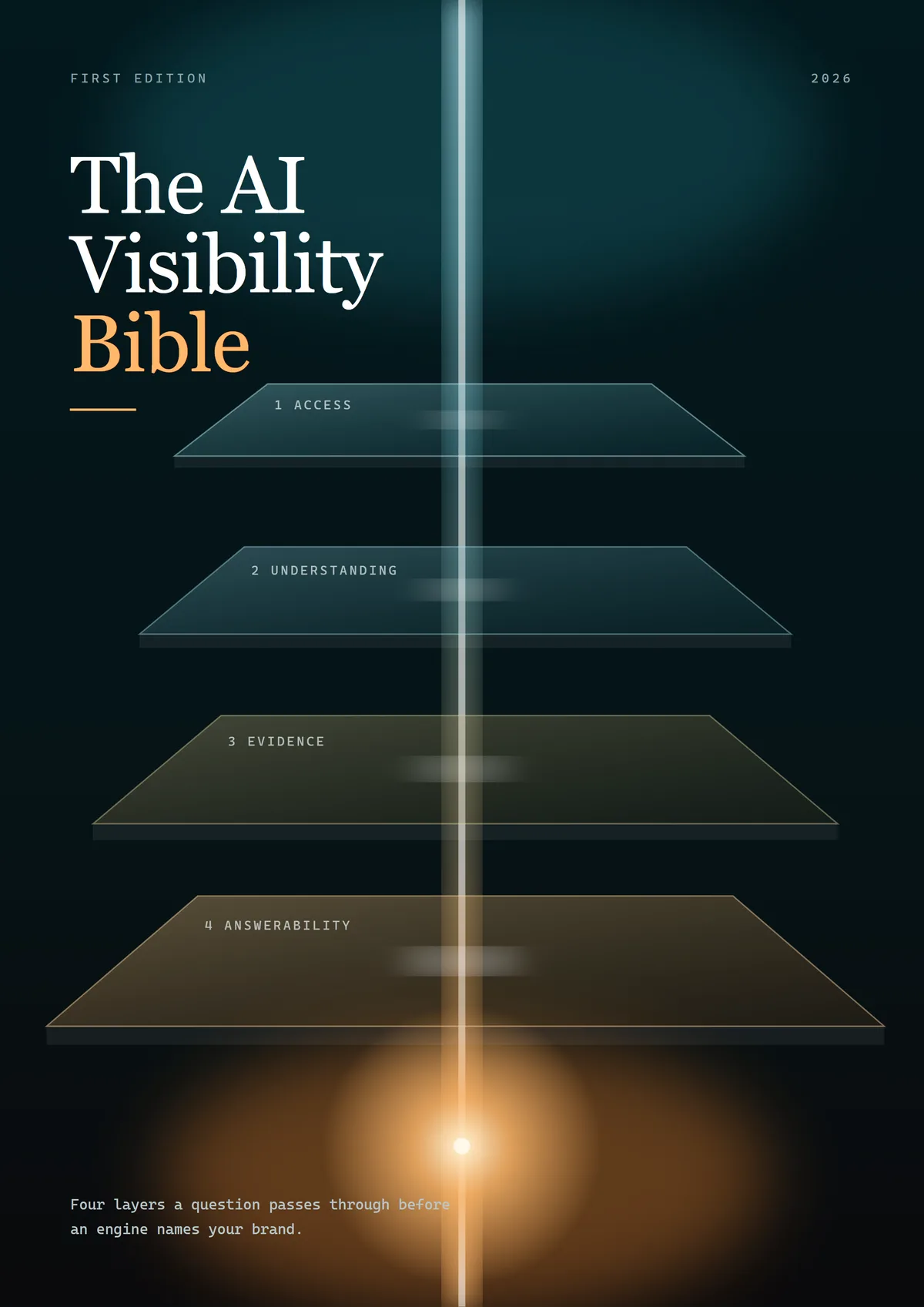
Four things have to be true, in order, before an AI engine names a brand: Access, Understanding, Evidence and Answerability. If one fails, the engine never gets to the ones after it, so fix the earliest one that fails.
Layer 1, Access: can the engine read your site?
Does your robots.txt let the AI search crawlers in?
Open yourdomain.com/robots.txt in a browser and look for these names: OAI-SearchBot, ChatGPT-User, PerplexityBot, Claude-SearchBot and Googlebot. If you see Disallow: / under any of those names, answer No. If it sits under User-agent: * and those names have no lines of their own, answer No too.
Seeing Google-Extended blocked? That doesn't affect Google's AI Overviews or AI Mode, which rely on Googlebot. Google says Google-Extended "does not impact a site's inclusion in Google Search."
Has someone confirmed your CDN or firewall isn't blocking AI bots?
Ask your web person: "Do we use Cloudflare or another CDN or firewall, and is any AI bot category blocked on any of our pages?" Answer Yes only if they've opened the security settings and nothing is blocked.
Checked September 14, 2026. These settings have changed more than once, so check your own security settings instead of assuming a default.
While you're at it: on a computer, open your main product or service page, turn JavaScript off in the browser's developer tools, and reload. If the price or your main claim disappears, most AI crawlers can't see it either.
First thing to do: fetch your robots.txt, check your CDN and firewall rules, then load your main page with JavaScript off.
How to fix it: Chapter 10Layer 2, Understanding: does the engine know what you are?
Does ChatGPT describe you correctly?
Ask ChatGPT: "What does your brand do, and who is it for?" Answer Yes if the answer is right, puts you in the right category, and doesn't mix you up with a company that has a similar name.
Does ChatGPT get your price right?
Ask: "How much does your brand cost?" and compare the answer with your pricing page today. If you don't publish a price and the answer states one anyway, answer No. When a brand publishes no price, engines fill the gap from whatever third-party source states one.
First thing to do: compare each claim in the answers with a short written note of your true facts, then search your own site for old numbers you published yourself.
How to fix it: Chapter 11Layer 3, Evidence: do sources you don't own back you up?
Do pages you don't own mention you?
Pick one question from your tally where a competitor was named and you weren't, and open its sources. Answer Yes if at least one page you don't own mentions your brand.
Would you be happy to see your first review profile quoted?
Search "your brand reviews". Answer Yes if the first review profile that comes up describes you fairly. Engines tend to quote the review profile that is easiest to find, not the one with the most reviews.
First thing to do: sort every source on the questions you lost into four groups: your own site, competitors' sites, publications, and community sites such as forums and review sites.
How to fix it: Chapter 13Layer 4, Answerability: do you own a sentence worth quoting?
Is there one sentence on your main page a writer would quote?
Pick the buyer question that matters most to you. On your main page, point to one specific sentence you would cite as the answer, such as a plain statement of what you offer and who it's for. Words like "industry-leading" or "best-in-class" don't count.
Does your site describe your category in your buyers' words?
Compare the words in your ten questions with the words on your main page. Answer Yes if the page names your category the way buyers do, not only in your own product terms.
First thing to do: run the citation test on your page for that question: name the sentence you'd quote.
How to fix it: Chapter 12
What to do with your result
The AI Visibility Bible, $79.99
The why behind your result, the fix for each layer, and the 18-sheet toolkit to measure it properly. 124 pages, 17 chapters, instant download.
Each layer has its own chapter in The AI Visibility Bible.
- Access: Chapter 10, Technical Access: Can the Engines Read You?Three things can make a brand invisible on their own: a robots.txt block, a firewall block, and pages the engines can't read without JavaScript. This chapter covers all three.
- Understanding: Chapter 11, Entity and Brand FactsHow engines decide whether your brand is one known, distinct company, and the work that gets your facts right.
- Evidence: Chapter 13, Third-Party Presence: The Source LayerWhy reviews, forums, comparison sites, press and directories carry more weight than anything you publish about yourself, and how to build a presence across them.
- Answerability: Chapter 12, Citable Content: Pages an Engine Can QuoteHow to write a page so an engine can lift one true, checkable sentence out of it.
- More than one layer: Chapter 16, Diagnosis and the Fix PlanHow to tell which layer is broken, so your effort goes where it can move the result.
- Make it a habit: Chapter 14, Measuring AI VisibilityHow to turn this one-off check into a measurement you can repeat, and tell a real change from ordinary noise.
Why this is worth your time
Brands cited in an AI answer earned 35% more organic clicks and 91% more paid clicks than brands that weren't cited, on the same search queries.
Seer Interactive, September 2025, 3,119 informational search queries.
Visits to US retail sites that came from AI assistants converted 60% higher than other traffic.
Adobe Analytics data for July 2026, as reported by Digital Commerce 360. US retail purchases only.
51% of B2B software buyers now start their research with an AI chatbot more often than with Google.
G2 survey of B2B software buyers, March 2026. Self-reported.
69% of B2B software buyers chose a different vendor than they first planned because of what an AI chatbot told them.
Same G2 survey, March 2026. Self-reported.
The common thread: people who arrive from an AI answer are, on average, further along in their decision.
One thing to set up this week
Add "AI assistant (ChatGPT, Perplexity, Gemini, or similar)" as an option in your "How did you hear about us?" field. Leads that came in before it was there can't be sorted afterward, so the sooner it's added, the more you'll know.
Want us to fix your AI visibility instead?
Book a call with us.
Or write to [email protected]
What this check can't tell you
One run is a snapshot. Most of the sources an engine cites change from one day to the next, so a single reading can't show a trend (Chapter 5, citing Schulte, Bleeker and Kaufmann, 2026).
Re-run the same ten questions in 30 days before you draw conclusions. Copy your results now so you have something to compare against.
The apps don't always agree. In our own checks, the ChatGPT app named a brand far more often than ChatGPT's API had on the same questions earlier that month, and Google's AI Overviews and AI Mode gave different answers to the same question in the same minute.
Your answers reflect your location and your account. Our benchmark was captured through a US connection with the market named in every question, so your numbers can differ from ours even in the same category.
This check helps you see and improve your AI visibility. Nobody can promise an engine will name you.
Questions
Why do I get a different answer when I ask the same question again?
Because the engines vary their wording, and often their sources, from one run to the next. One answer is one observation. Twenty answers across ten questions show a pattern, and asking the same questions again a month later shows whether it holds.
Do I need API access to check my AI visibility?
No. The ChatGPT app and Google AI Mode are what your buyers use, so asking there shows what they see. APIs make a check repeatable at scale, but they give you a stand-in for the buyer's view, and they can name different brands than the apps do.
What counts as a good number?
There's no fixed pass mark. In our US benchmark (US, September 2026, one run), one brand was named in every answer in 5 of 10 categories, and no brand managed that in the other 5. The useful comparison is against the two or three competitors named first in your own answers, engine by engine.
Does Google AI Overviews count?
It's a different Google surface from AI Mode, and the two can give different answers to the same question. Both run on Google's ordinary Search index, so the Access checks cover both. To check AI Overviews too, search the same ten questions on Google from a Google account in your buyers' country, and count the answers separately wherever an AI Overview appears.